
The Backend Is Built In
No Express. No Django. No Rails. FLIN is a complete backend framework — API routes, database, authentication, file storage, background jobs, and 420+ server-side functions. All in one binary.
Backend vs. Dashboard — What's the Difference?
Many beginners confuse the backend with the admin dashboard. Think of a restaurant: the frontend is the dining room, the backend is the kitchen, the API is the waiter — and FLIN is the food truck that does it all.
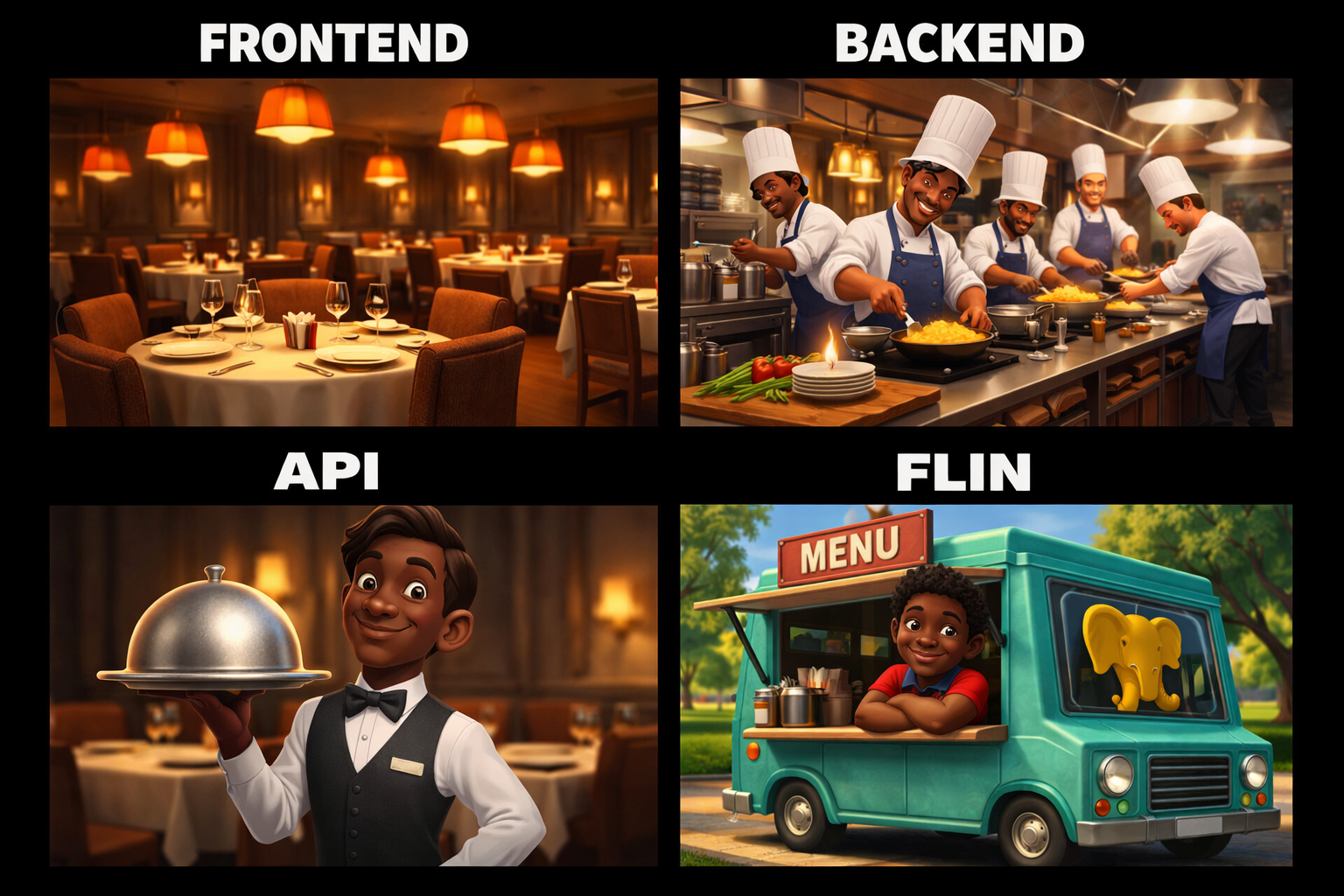
Backend
The engine behind the scenes. Handles data, logic, authentication, file processing, emails, and API responses. Users never see it directly — but everything depends on it.
Admin Dashboard
A visual interface to manage your app's data. Browse records, view metrics, run queries. It's a frontend built on top of the backend — not the backend itself.
FLIN
Both at once. Write backend logic in .flin files, and FLIN auto-generates the admin dashboard at /_flin. No separate tools, no separate deployment.
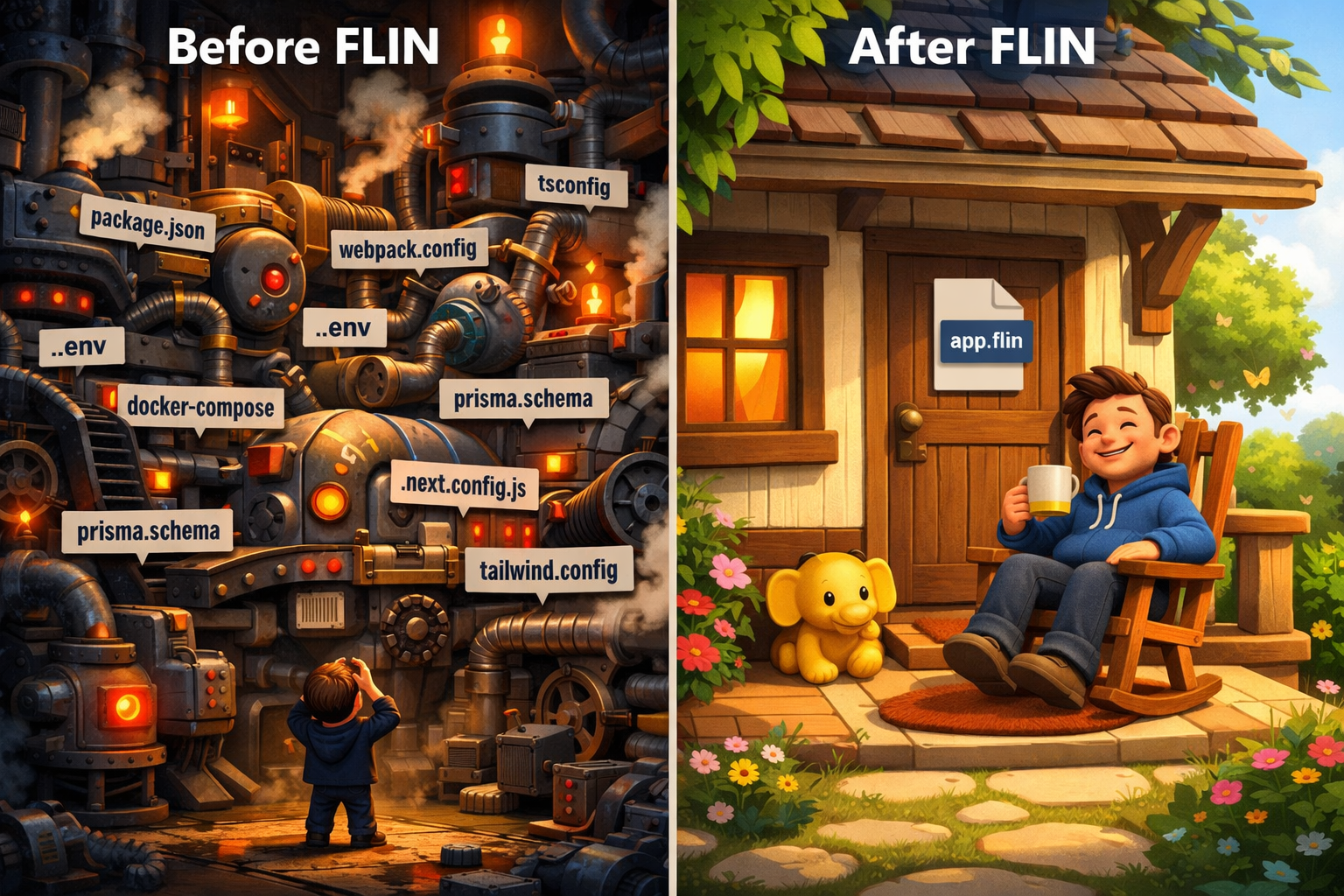
Before FLIN vs. After FLIN
Traditional backends require dozens of config files, package managers, and build tools. FLIN replaces all of that with a single binary and .flin files.
Everything a Backend Needs
FLIN's backend isn't a toy — it's production-grade. Here's everything you get out of the box, with zero npm installs.
API Routes
Define route GET /users and route POST /users with guards, validation, and response helpers. File-based routing — app/api/users/[id].flin becomes /api/users/:id.
Embedded Database
FlinDB is built into the binary. WAL with CRC-32 checksums, auto-checkpointing, per-entity data files. save user writes to disk. No PostgreSQL, no connection strings.
Authentication
Sessions, 8 OAuth providers, 2FA/TOTP, JWT, bcrypt, WhatsApp OTP — all native functions. Middleware guards protect routes. No Passport.js, no Auth0.
File Storage
Upload files with a file type field. 9 document formats auto-parsed (PDF, DOCX, XLSX...). Cloud backends: Local, S3, R2, GCS. Download grants for secure sharing.
Background Jobs
Queue tasks with job_queue(), check status with job_status(), schedule recurring work with job_recurring(). Built into the runtime — no Redis, no Bull, no Celery.
send_email(to, subject, body) — one function. HTML templates, attachments, and bulk sending. Configure SMTP credentials in .env and you're done.
HTTP Client
http_get(), http_post(), http_put(), http_delete(), http_patch(). Call any external API from your backend. JSON parsing included.
Cryptography
bcrypt_hash(), aes_encrypt(), sha256(), hmac(), jwt_encode(), totp_secret(). Production-grade crypto without OpenSSL headaches.
Validation
43 decorators: @required, @email, @minLength, @max, @one_of, @unique, @index. Declare constraints on entities and route bodies — FLIN enforces them.
A Complete API in One File
Here's a full CRUD API with authentication, validation, and error handling. No framework, no ORM, no boilerplate.
entity Product {
    name: text @required @minLength(2)
    price: money @min(0)
    category: text @one_of("Electronics", "Books", "Clothing")
    description: semantic text
    image: file
    active: bool = true

    @index(category)
    @index(active, category)
}

// List products with filtering
route GET /api/products {
    category = query.category
    products = match category {
        none -> Product.where(active == true)
        _ -> Product.where(active == true && category == category)
    }
    response.ok({ products: products })
}

// Create product (auth required)
route POST /api/products {
    guards { auth: required, csrf: required }
    validate {
        name: text @required
        price: money @required @min(0)
        category: text @required
    }
    product = Product {
        name: body.name,
        price: body.price,
        category: body.category,
        description: body.description
    }
    save product
    response.created(product)
}

// Semantic search ("comfortable office chair")
route GET /api/products/search {
    results = search query.q in Product
    response.ok({ results: results })
}

// Delete product
route DELETE /api/products/:id {
    guards { auth: required }
    product = Product.find(params.id)
    if product == none {
        response.not_found("Product not found")
    }
    delete product
    response.ok({ deleted: true })
}
420+ Server-Side Functions
Every function runs on the server. No client-side JavaScript needed for business logic. Here's a sampling of what's available.
Strings
trim, split, join, replace, slugify, base64, url_encode, pad...
35 functionsMath
abs, round, sqrt, pow, sin/cos, random, gcd, factorial, median...
35 functionsLists
push, pop, sort, unique, map, filter, reduce, zip, group_by...
34 functionsDate/Time
now, today, format_date, add_days, diff_days, is_weekend...
35 functionsCrypto
uuid, md5, sha256, bcrypt, jwt, aes_encrypt, hmac, totp...
18 functionsValidation
is_email, is_url, is_uuid, matches_pattern, is_strong_password...
20 functionsHTTP Client
http_get, http_post, http_put, http_delete, http_patch, http_head
7 functionsEmail & PDF
send_email, pdf_from_html, image processing, file conversion...
10 functionsAI
ask_ai, search (semantic), keyword_search, 8 LLM providers...
15 functionsAuth
8 OAuth providers, sessions, 2FA/TOTP, WhatsApp OTP, JWT...
25 functionsEntities
save, delete, destroy, where, find, order_by, sum, avg, count...
24 functionsMaps
keys, values, has_key, get, set, merge, pick, omit, entries...
15 functionsMiddleware & Guards
Protect your routes with a single file. Authentication, CSRF protection, rate limiting, and role-based access — all declarative.
middleware {
    matcher: ["/dashboard/**", "/api/**"]
    exclude: ["/", "/login", "/register"]

    // Check authentication
    if session.user == none {
        redirect("/login")
    }

    // Continue to route handler
    next()

    // Post-handler: add headers
    set_header("X-Powered-By", "FLIN")
}
Route Guards & Validation
Every route can declare guards and validation rules. FLIN rejects invalid requests before your code runs.
route POST /api/orders {
    // Guards — reject before processing
    guards {
        auth: required
        csrf: required
    }

    // Validation — reject if body is invalid
    validate {
        product_id: int @required
        quantity: int @required @min(1) @max(100)
        email: text @required @email
        notes: text @maxLength(500)
    }

    // Your code — only runs if guards + validation pass
    product = Product.find(body.product_id)
    if product == none {
        response.not_found("Product not found")
    }

    order = Order {
        product_id: body.product_id,
        quantity: body.quantity,
        email: body.email,
        total: product.price * body.quantity
    }
    save order

    // Send confirmation email
    send_email(body.email, "Order Confirmed", "Your order #" + to_text(order.id) + " is confirmed.")

    response.created(order)
}
Guards
auth: required rejects unauthenticated requests. csrf: required validates CSRF tokens. Guards run before validation.
Validate Block
Declare expected fields with types and decorators. Invalid requests get a 400 Bad Request with field-level error messages — automatically.
Response Helpers
response.ok(), response.created(), response.bad_request(), response.not_found(), response.forbidden(), response.conflict().
File-Based Routing
Your file structure is your routing table. No router configuration, no route registration, no mapping files.
myapp/
├── app/
│   ├── index.flin            → GET  /
│   ├── about.flin            → GET  /about
│   ├── _middleware.flin      → Auth guard
│   ├── dashboard/
│   │   ├── index.flin        → GET  /dashboard
│   │   └── settings.flin     → GET  /dashboard/settings
│   └── api/
│       ├── users.flin        → GET|POST /api/users
│       └── users/
│           └── [id].flin     → GET|PUT|DELETE /api/users/:id
├── entities/
│   └── User.flin             → Entity definition
├── components/               → Reusable UI
├── layouts/                  → Page wrappers
├── i18n/                     → Language files
└── .flindb/                  → Database (auto-created)
Transactions & Background Jobs
Complex backend operations — atomic transactions, scheduled tasks, and async processing — all built in.
// Atomic transaction — all or nothing
begin_transaction()
    order = Order { user_id: user.id, total: total }
    save order

    payment = Payment { order_id: order.id, amount: total }
    save payment

    user.balance = user.balance - total
    save user
commit_transaction()

// Background job — non-blocking
job_id = job_queue("send_invoice", {
    order_id: order.id,
    email: user.email
})
status = job_status(job_id)

// Recurring job — cron-like
job_recurring("cleanup_expired", "0 2 * * *")
job_schedule("send_reminder", add_hours(now(), 24))
Auto-Generated Admin Console
Every FLIN app ships with a full admin dashboard at /_flin. It's not a separate project — it's generated from your backend code.
Entity Browser
Browse, search, sort, create, edit, and delete records for every entity. Inline editing, bulk actions, CSV export.
Query Editor
Execute FLIN queries live: User.where(active == true).count. Query history saved in IndexedDB.
REST API Docs
Auto-generated Swagger-like documentation for all your routes. Test endpoints directly from the browser.
Real-Time Metrics
Request counts, response times, status codes, memory usage, database size — live gauges refreshing every 5 seconds.
Request Logs
Filterable log viewer with level, source, and search. Auto-polling every 2 seconds. Clear logs with one click.
AI Gateway
Monitor AI provider usage, check API key configuration, and manage embedding providers from a single panel.
Your Backend, Simplified
Stop juggling 15 tools. Install FLIN, write your logic, and ship. The backend is already there.
curl -fsSL https://flin.sh | bash